K12 Education Data Guide

Why Generic B2B Data Falls Short in K–12 Marketing
Schools and districts have specialized roles, buying processes, data challenges, and email environments that require a different approach to targeting.
Build List Contact Us Request Sample FileSelling to schools and districts requires a different approach than selling to traditional businesses.
K-12 organizations have specialized job roles, layered purchasing processes, distinct budget cycles, and strict email security practices. A contact may remain at the same school but move to a different grade, subject, department, or administrative role. The person who processes an order may also be different from the educator or department leader who selected the product.
These differences are easy to miss when marketers rely on databases designed around ordinary corporate structures.
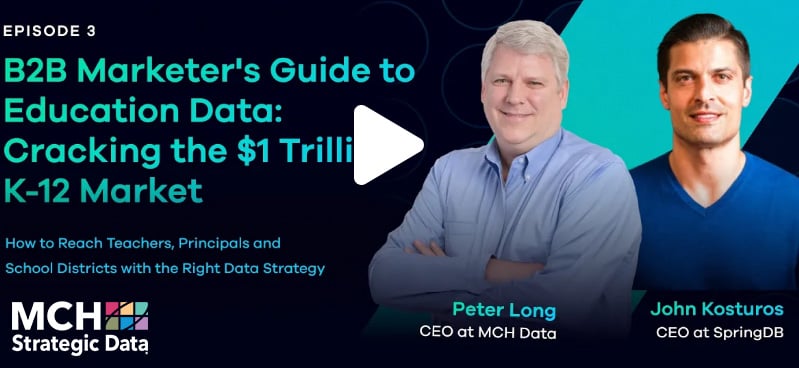
In a recent episode of the SpringDB Data Exchange Podcast, MCH Strategic
Data CEO Peter Long joined host John Kosturos to discuss what makes the education market different and why effective K-12 targeting depends on data built specifically for schools and districts.
Watch the SpringDB Education Data Episode
Education Roles Do Not Fit a Standard B2B Model
Most general business databases are organized around familiar corporate functions such as sales, finance, operations, human resources, and executive leadership. Schools and districts have a much more specialized structure.
A K-12 organization may include classroom teachers, curriculum leaders, special education staff, technology administrators, principals, district executives, transportation directors, food service personnel, facilities teams, purchasing staff, and many other roles that do not translate neatly into a standard business taxonomy.
Even a seemingly simple category such as teacher contains significant variation. Titles may reflect grade, subject, department, program, local terminology, or more than one responsibility. Two educators performing similar work may have very different titles, while two people with similar titles may serve very different audiences.
Without education-specific job-function normalization, marketers may reach too many irrelevant contacts while overlooking the people who are actually connected to the purchase.
MCH organizes education personnel by their roles within schools and districts, helping marketers build audiences around the responsibilities that matter to a particular product or service.
A Working Email Address Is Not the Same as an Accurate Record
Contact data can be technically valid and still be wrong for the campaign.
An educator may keep the same email address while moving from one grade to another, changing subjects, taking on a department leadership role, or transferring to another school in the district. An administrator may remain employed but have an entirely different set of responsibilities than they did the previous year.
For marketers, this distinction matters. A message intended for elementary reading teachers will not become relevant simply because it reaches a valid district inbox.
Useful education data must reflect what a person currently does, where they work, and how their role fits within the institution. That requires more than identifying whether an email can be delivered. It requires ongoing research and verification of the person, the position, and the organization.
5M+ education contact records updated each month
MCH combines web research, human review, and direct verification to maintain the institutional and personnel details needed for more precise K-12 targeting.
More than 5 million education contact records are updated through MCH’s data processes every month - not simply through a once-a-year refresh. This ongoing work helps provide K–12 marketers with cleaner, more accurate audience data throughout the school year.
The Person Processing the Order May Not Be the Person Choosing the Product
School purchases often involve several people. A teacher may identify a classroom need and recommend a product. A curriculum leader or department chair may evaluate it. A principal or district administrator may approve the expense. Purchasing staff may then issue the final order.
Looking only at the name on a purchase record can therefore create an incomplete picture of how the decision was made.
Depending on the product, the buying group may include classroom educators, school administrators, curriculum staff, technology leaders, finance personnel, purchasing departments, program directors, or district executives.
Effective targeting begins by understanding who influences the decision, who approves it, and who completes the transaction.
School Email Requires a Different Deployment Strategy
Accurate audience selection does not guarantee that a campaign will reach the inbox.
Schools and districts operate highly protected email systems. These systems are designed to guard large networks of staff and students from spam, phishing attempts, ransomware, and other threats. When a sender delivers a large volume of similar messages into one district domain, the activity may trigger filtering or blocking across the entire organization.
Successful education email campaigns require careful segmentation, controlled sending volume, domain-level throttling, proper authentication, relevant messaging, and ongoing attention to sender reputation.
This is also why more contacts do not automatically create a stronger campaign. Sending a relevant message to a focused audience is generally more effective and safer than sending the same message broadly across every available educator or administrator.
MCH helps education marketers combine targeted contact data with email deployment practices designed for school and district environments.
Timing Is Part of the Targeting Strategy
Schools do not purchase according to the same calendar as most commercial businesses.
Budget approvals, school-year transitions, curriculum adoption schedules, grant deadlines, testing periods, staffing changes, and back-to-school planning all affect when buyers are most likely to evaluate products and services.
A campaign may reach the correct person and still arrive at the wrong time. Conversely, a well-timed message can help a vendor become familiar before a planning cycle begins or provide useful information while a district is defining its requirements.
Effective K-12 marketing connects the audience, the message, and the timing rather than treating them as separate decisions.
Watch the SpringDB Conversation
In the SpringDB Data Exchange Podcast, Peter Long and John Kosturos discuss why general B2B data models often fall short in education, how school roles and buying processes differ from corporate structures, why education data changes quickly, and what marketers should understand before sending email into school districts.
The conversation also explores how education data can support sales prospecting, CRM enrichment, email marketing, market analysis, and programmatic audience development.
Reach the Schools and Decision-Makers That Matter
MCH Strategic Data helps companies identify and reach schools, districts, administrators, educators, and other institutional decision-makers throughout the K-12 market.
MCH education data can support:
- Email marketing and direct mail
- Sales prospecting and account-based marketing
- CRM enrichment and market analysis
- Programmatic audience development
Build a targeted K-12 list through MCH ListBuilder or talk with our team about developing an audience for your specific market, product, or campaign.





Need More Time?
Due to inactivity, you will be logged out within 5 minutes.
To stay logged in, please select Stay Logged In.
 Logout